We remain fully operational. Our teams are working around the clock to ensure your deliveries continue safely.

DOWNLOAD THE APP


Copyright © 2025 Desertcart Holdings Limited
DOWNLOAD THE APP
Buy anything from 5,000+ international stores. One checkout price. No surprise fees. Join 2M+ shoppers on Desertcart.
Desertcart purchases this item on your behalf and handles shipping, customs, and support to Papua New Guinea.
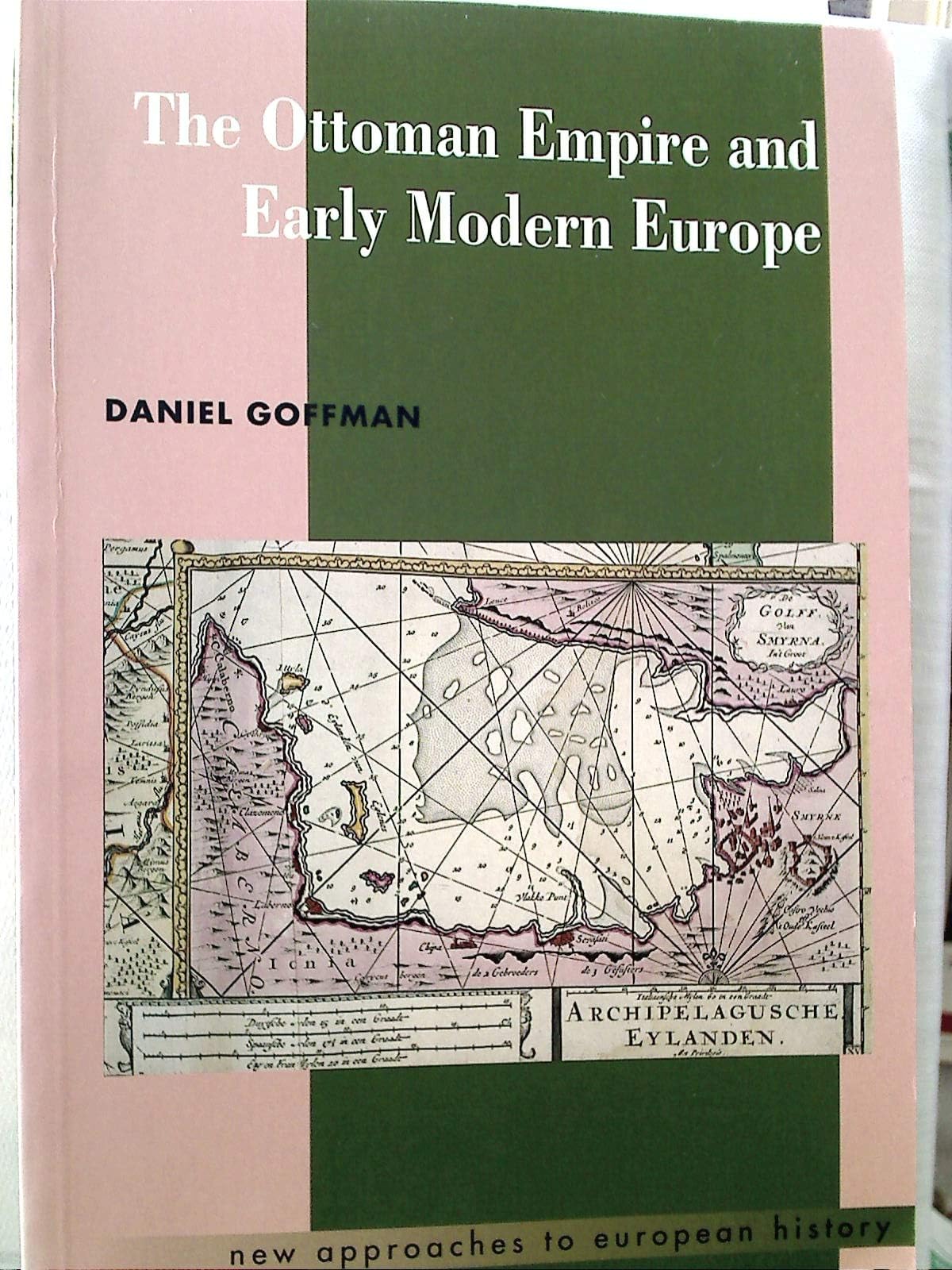
desertcart.com: The Ottoman Empire and Early Modern Europe (New Approaches to European History, Series Number 24): 9780521459082: Goffman, Daniel: Books Review: Fast delivery!!! - This book came in fast and it was in perfect condition as well! Also it's a great book and very helpful for a history class about the Ottoman Empire. Review: good introduction to the Ottoman Empire - This good provides a good introduction to the history of the Ottoman Empire and it's place in Medieval and Early Modern Europen history. Although it provides a more "big man" perspective of life in the Ottoman world.
| Best Sellers Rank | #321,801 in Books ( See Top 100 in Books ) #22 in Middle Eastern History (Books) #102 in Turkey History (Books) #7,226 in World History (Books) |
| Customer Reviews | 4.1 4.1 out of 5 stars (26) |
| Dimensions | 5.99 x 0.68 x 9.02 inches |
| ISBN-10 | 0521459087 |
| ISBN-13 | 978-0521459082 |
| Item Weight | 15.2 ounces |
| Language | English |
| Part of series | New Approaches to European History |
| Print length | 300 pages |
| Publication date | May 6, 2002 |
| Publisher | Cambridge University Press |
D**N
Fast delivery!!!
This book came in fast and it was in perfect condition as well! Also it's a great book and very helpful for a history class about the Ottoman Empire.
L**Y
good introduction to the Ottoman Empire
This good provides a good introduction to the history of the Ottoman Empire and it's place in Medieval and Early Modern Europen history. Although it provides a more "big man" perspective of life in the Ottoman world.
R**S
The Ottoman Empire as a European Power
Daniel Goffman has produced an excellent book which EVERY EUROPEAN HISTORIAN should read and take into account as they prepare their courses and publications.
J**G
it is very interesting to get a look at that great and richly diverse empire
Very interesting. Written more for the academic than the lay reader. That being said, it is very interesting to get a look at that great and richly diverse empire.
A**A
Yawn 🥱
This book failed to keep my attention, and I am a history major. The authors writing style just isn’t my cup of tea; however, it is filled with a lot of information that was useful for my graduate course.
T**M
Intriguing Read!!
The Ottoman Empire and Early Modern Europe, written by Daniel Goffman, tries to revisit the unique relationship between the Ottoman Empire and Europe. Goffman does this by looking at European history through a different set of eyes than historians who came before him, whom he charges with being responsible for Orientalism. He notes that although the Ottoman capital city, Istanbul,--and more than one-third of the empire--were within the continent of Europe, the Ottomans Empire was perceived to be divided from the west because of its culture and religion. By reexamining the Ottoman's military, its tyranny, the sexual appetites of its sultans, Goffman has tried to de-exoticize what people have exoticized about this empire. Consequently, Goffman approaches the history and institutions of the once-mighty Ottoman Empire from a new viewpoint. All this makes him conclude that this empire should be considered European rather than oriental. His purpose for writing this book was to show the reader the many similarities between Europe and the Ottoman Empire. Goffman did this by examining two characteristics of the Ottoman Empire: the state's government and its relations with Western Europe (p.12). Goffman also tries to incorporate a personal character throughout the book. He does this by illustrating a short story from the life of a certain Kubad. These short stories are primarily inserted to produce a storyline piece to this work that is otherwise a survey. From these fragments of Kubad's life, the author allows himself some freedom to fill in gaps in Kubad's life. While Goffman does inform his reader's when he is making assumptions, this kind of freedom he takes can make one question his credibility. At the end of the day, Goffman's way of inserting small bits and pieces about Kubad's life one may find helpful while others confusing. Therefore, Goffman does what many experienced writers try to do: create a work which is original, but still true to historical facts (p.23). Goffman, while writing this book, writes that any historian cannot fully comprehend the history of Western Europe, around the time of the early modern period, without examining the Ottoman Empire (its influence was greater than many assume). He wrote, "Unlike other major religions such as Hinduism or Taoism, Islam and Christianity are rooted in essentially the same Near Eastern and unitary doctrine" (p. 8). Instead of writing this book from a Eurocentric point of view, Goffman writes from an Ottocentric point of view. Approaching the subject in such a fashion allows him to highlight the similarities between the rest of the continent of Europe and the Ottoman Empire; and, as a result, this helps evaporate some of the ideological dissimilarities. All through the book, Goffman stresses that throughout the early modern period, most Europeans viewed the Ottoman Empire as part of Europe rather than the Orient. This is due to the fact that after the Ottomans conquered Constantinople (later renamed Istanbul) in 1453, they inherited the Byzantine Empire; this helped solidify their power/presence in Europe. As a result, Goffman argues, it wasn't only until the late eighteen hundreds that Western Europe began to look at the Ottomans as non-European (p.74-76). The author writes that, today, we have no real record of what is now known as the early Ottoman Empire, besides a few architectural remains and coins. Essentially, all that we know of the first rulers, known as emirs--Orhan, Osman, and Murad--is by way of secondary resources. A number of sources originate from Byzantine, Genoese, and other places to create this artificial, literary creation of a state; a great deal of it comes from histories of later Ottomans who recreated the past from jumbled memories of their elders, in order to validate or denounce the Ottoman state as it appeared in the fifteenth and sixteenth centuries. In addition, Goffman states historians today must filter through the fitful thoughts of apprehensive foreigners competing with a growing Islamic state. Moreover, historians are forced to sift through the creation of self-serving recollections of delegates of an established world empire as he or she attempts to recreate the birth of this world state. This leaves modern historians in a dilemma: they either can chose to believe the politicized sources (which try to legitimize the Ottoman dynasty) or the writings of the enemies of the Ottomans. Thus, some argue, we get information that is either praising the Ottomans or condemning them but no sources that are unbiased which could reveal the true reality of its foundation. Some historians believe the words of Ottoman records, written down two or three generations after the events, appearing at times to take factually such myths as Osmans's dream of a moon floating from a Sufi Shaykh into his navel. Therefore, when looking at sources about the early Ottoman Empire, historians have to be careful to discern between apparent biases and subliminal ones (p. 28-30). By de-exoticizing the Ottoman Empire, Goffman has shown in this book that, contrary to popular belief, the Ottomans weren't warmongering, bloody savages but in some ways more advanced and civilized than Western Europe. He argued that while Western Europe was for the most part intolerant of other religions, in Istanbul one could find Jews, Christians, and Muslims living peacefully side-by-side, which was practically unheard of in Western Europe, at that time. Many Jewish refugees fleeing the Spanish Inquisition came and settled within the borders of the Ottoman Empire, and would not only live there but thrive as merchants, jewelers, bankers, etc. Also Orthodox Greeks found the Ottoman Empire a safe haven from the intense persecution which Catholics of Western Europe bestowed upon them. In addition, Armenians, who were Christians, found this empire a place where they could thrive via trading silks and other valuable goods. Besides living and thriving in the Ottoman Empire, Jews, Christians, Armenians, Orthodox Greeks, and other minority groups had the chance of rising up to influential places in this society, something practically unheard of in early modern Western Europe. Something else that the author highlighted was that in the early beginnings of the Ottoman Empire the majority of the inhabitants of the Anatolia peninsula were Christians. This meant that many who have perceived the religion of the Ottoman Empire to be exclusively Muslim were mistaken. The Muslim religion would only later dominate the Ottoman Empire, but it still had a large Christian community within its borders. Hence, Goffman made sure his readers understood that the Ottoman Empire wasn't as exotic as some historians of the past have made this empire out to be (p.138). Goffman by writing The Ottoman Empire and Early Modern Europe has helped shed light on a subject greatly misunderstood by previous historians and by Western Europeans in general. Having made the Ottoman Empire less alien, Goffman has allowed his readers to see a history that has long been Eurocentric until now. Goffman didn't shy away from exposing myths about the Ottomans which have clung to it, throughout the centuries. Thus, this book is most certainly a new approach to European history. It allows the reader to see that the Ottoman Empire truly belongs in European history; and that without examining it, one cannot fully comprehend the history of Western Europe around the time of the early modern period (p.1-3).
N**N
Expensive!
Too expensive, price is too much for a kindle book, a kindle book must be much cheaper than its printed version.
R**N
Very Good
This is primarily an analysis of the Ottoman Empire during the Early Modern period. Basic narrative is included but Goffman's primary interest is in discussing the basic features of the empire and, in particular, rebutting some historiographic stereotypes. In this well written book, Goffman presents the basic narrative from approximately the early 14th century to the end of the 17th century. Goffman describes the construction of the Ottoman state, its evolution over time, and the way Ottoman institutions changed as a result of interactions with other states, particularly with Catholic Europe. There is a nice description of basic institutions of the Ottoman state and their evolution. The imperial court, the basic structure of the bureaucracy, the use of slave retainers, the pseudo-feudal use of landholders, and the relationship to Islam are discussed well. Goffman shows, for example, how the famous janissery corps were used to extend military power, guarantee a loyal following for the court, and counterbalance the power of traditional Turkic warriors. The development and evolution of the corps is laid out well. Similarly, Goffman describes quite well how succession practices and the relationships will Islam changed over this period. Goffman is particularly concerned with 2 major themes. One is the relatively syncretic and creative nature of the Ottoman state. The Ottomans are shown to adopt governing practices from a variety of sources incluidng Central Asian, Persian, Arab, Byzantine, and European traditions. He emphasizes the considerable flexibility of Ottoman institutions across this period. A second theme is the ways in which the Ottoman Empire was strongly integrated with the developing European state system and European commerce. The Ottomans are shown to be involved in the kind of diplomacy pioneered by Renaissance Italian city-states. Commercial involvement was even greater because of the interposition of the empire between Europe and the rest of Asia. Some aspects of Ottoman life, particularly its relative religious tolerance, were important in commercial networks. Like all the books in this series, there is a nice bibliography for further reading.
A**R
helped me smash my second year uni exam init big ups Goffman
Trustpilot
5 days ago
3 days ago